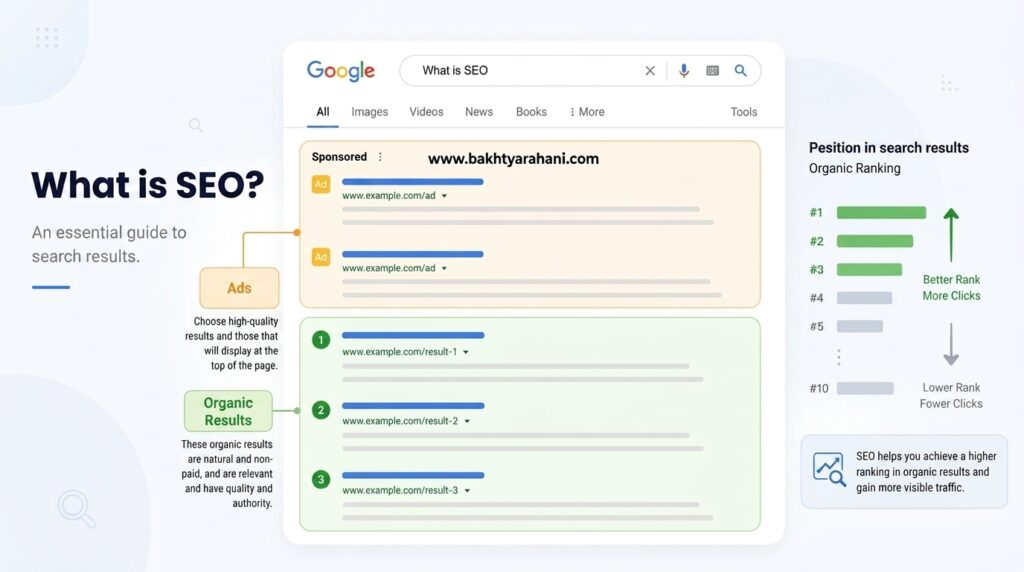
SEO (Search Engine Optimization) means optimizing a website for search engines like Google so it appears higher than competitors in relevant search results. To get started you need to optimize page content, site speed, and internal and external linking; the first real results usually show up within three to six months.
SEO stands for Search Engine Optimization. In plain terms, SEO means making sure that when someone searches Google for something you offer, your website shows up before your competitors do.
Here’s an example. Say someone in Tehran searches for «urologist Tehran». Why do some websites rank at the top and others never show up at all? The answer is exactly that: SEO.
The difference between SEO and paid search (Google Ads) matters here too. With ads, every click costs money, and results stop the moment you stop paying. SEO is a long-term investment: once it starts working, you keep getting traffic without paying per visit.
Why does SEO matter for your business?
SEO takes patience, unlike ads that get results the moment you turn the budget on. But the payoff is bigger: most people trust organic Google results more, even if they never admit it consciously.
Case Study: From Zero to Ten Cancer-Patient Referrals a Month with Local SEO
In 2024, I worked on a real project: an oncology referral platform in Tehran whose goal was connecting cancer patients with the best doctors in the city, but it simply wasn’t showing up in relevant search results – the kind of situation where competitors were capturing exactly the same searches.
Based on that, I built what I call a «search intent map» for the business: we rebuilt the content around pages patients were actually searching for (specific cancer types, doctor selection criteria, treatment stages), cleaned up the patient-referral funnel to make it clearer and more accessible, and fixed the site’s technical structure for local searches tied to cancer care.
The result over a few months was measurable: referrals of cancer patients to Tehran’s top doctors went from zero to roughly ten patients a month, purely through organic search, with no separate ad budget. This same project is what convinced me to treat medical SEO as a genuine specialty, not a side service bolted onto web design.
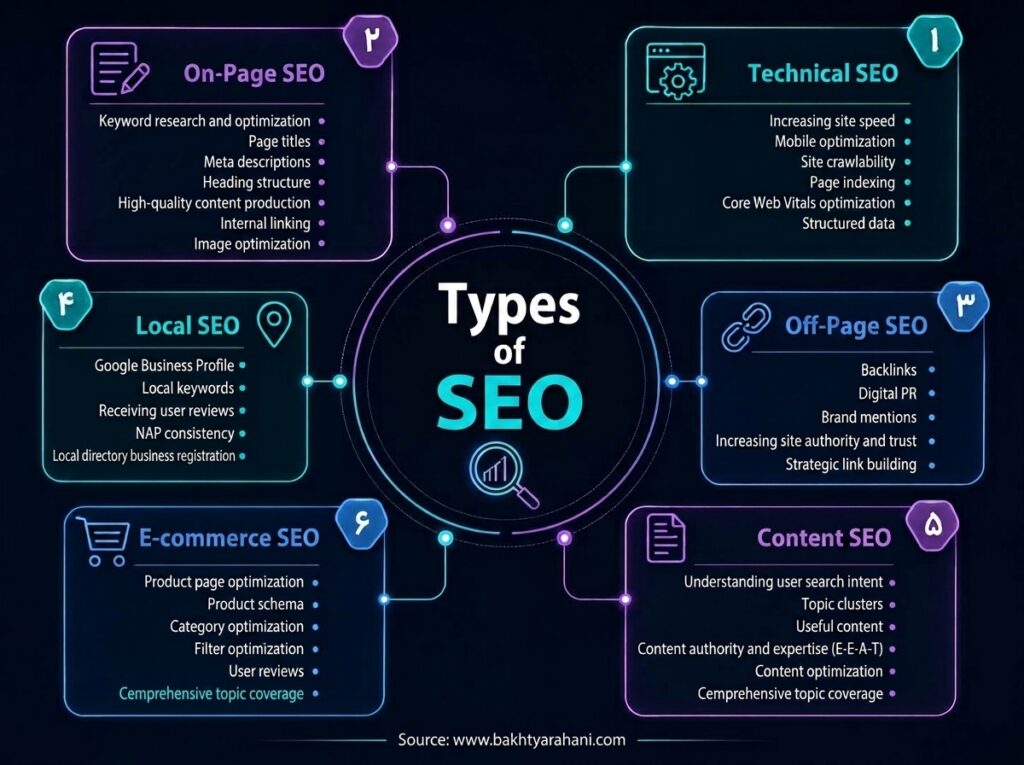
Know the different types of SEO
SEO is not one single task. It breaks down into three core areas, and each one plays a different role.
On-Page SEO
Everything you control directly on your own pages: content quality, title tags, meta descriptions, heading structure (H1 to H6), and internal linking between related pages.
Technical SEO
The infrastructure behind your site: page speed, mobile-friendliness, URL structure, your XML sitemap, and making sure Google can crawl and index your site without errors.
Off-Page SEO
Everything that happens outside your site but still affects your ranking: backlinks from credible sites, domain authority, and your presence across social platforms.
| Type of SEO | Main Focus | Practical Example |
|---|---|---|
| On-Page SEO | Content and page structure | Optimizing title tags and meta descriptions |
| Technical SEO | Infrastructure and site speed | Compressing images, building a sitemap |
| Off-Page SEO | Site authority off-site | Earning backlinks from credible sites |
White hat, black hat, and grey hat SEO
White hat SEO means playing strictly by Google’s rules: real, useful content, natural link building, and genuinely improving user experience. Results take longer, but they last.
Black hat SEO relies on tricks like buying links or stuffing hidden text to game the algorithm. It can produce fast results, but the moment Google’s algorithm catches up, rankings collapse – sometimes along with the entire site getting removed from results.
For any brand or business planning to operate for years, white hat is the only sustainable path.
| Criterion | White Hat SEO | Black Hat SEO |
|---|---|---|
| Method | Real content, natural link building | Buying links, copied or spammy content |
| Speed of results | Slow but lasting | Fast but temporary |
| Risk | Nearly zero | Complete removal from Google results |
Where do you start? 6 practical steps for beginners
- Keyword research: Understand exactly what your audience is searching for.
- Audit your current site: Use Google Search Console to see where you stand right now.
- Optimize existing pages: Fix titles, meta descriptions, and the content on your live pages.
- Publish content consistently: Build articles and pages around the keywords you found.
- Build internal and external links: Connect your related pages to each other, and work on earning quality backlinks.
- Measure and improve: Track your results in Search Console and adjust your approach based on real data.
How long until you see SEO results?
This is the question I get asked most. The honest answer: expect 3 to 6 months for the first real movement, with meaningful results typically landing between month 6 and month 12. Anyone promising results in a week or two is usually relying on black hat shortcuts.
AI's role in SEO today
One of the biggest shifts in the past few years is how AI tools have entered SEO workflows. They can run keyword research in minutes, generate content clusters, and analyze competitors faster – and far more thoroughly – than doing it by hand.
Given my background in AI, I build these tools directly into my SEO projects. The result is faster research and sharper decision-making, without cutting corners on human judgment. You can read more about my take on artificial intelligence here.
Frequently Asked Questions
SEO (Search Engine Optimization) is a set of techniques that help your website rank higher in Google’s search results and attract organic traffic without paying for ads.
SEO has three main types: on-page SEO (optimizing content and pages), technical SEO (site speed and infrastructure), and off-page SEO (backlinks and site authority). All three need to move forward together.
Learning the basics yourself is a fine starting point, but scaling it usually takes time or specialized skill most business owners don’t have.
Tools like Rank Math make technical and on-page work easier, but the fundamentals of SEO stay the same across every platform.
You can absolutely start on your own. But once you’re competing for high-value keywords or customers, working with a specialist tends to shorten the path considerably.
Local SEO means optimizing for searches tied to a specific area, like «dentist near me». It matters for any business with a physical presence, from clinics to restaurants.
Wrapping up and next steps
SEO is not a single move, it’s one of the most durable investments you can make in your business. Start today, and in six months you’ll be somewhere your competitors, who haven’t started yet, simply aren’t.
If you’d like a closer look at your own site’s SEO position, you can book a free 30-minute consultation with me, or check out the SEO services page.